
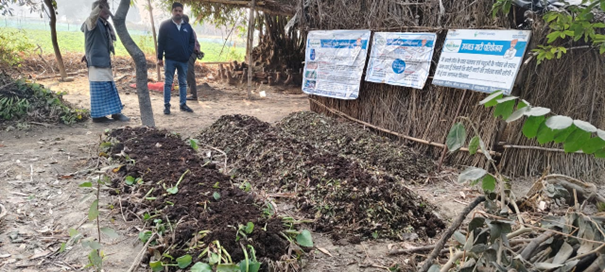
It’s a dream come true for Sukhpal. As he stands in his field, he runs his hand over the dark, crumbly soil with a sense of satisfaction. Barely three years ago, this same earth was pale and lifeless, run down by decades of chemical dependency. Today, it abounds with the kind of vitality that only organic matter can bring. For this small farmer in Raipur village, Hardoi district, the journey from despair to hope has been nothing short of a revolution. “I was trapped in a vicious cycle,” Sukhpal recalls, his weathered face reflecting years of struggle. Until DCM Shriram Foundation and FINISH Society stepped in, “every season, I poured more DAP and urea into my 3.5-bigha land, yet the yields kept falling. The costs kept rising, but my harvest didn’t.” It is a story familiar to scores of Indian farmers-caught between rising input costs and diminishing returns, watching helplessly as their ancestral lands slowly die. The turning point came when the Upjau Maati Project team, funded by Shriram Foundation and implemented by the FINISH Society, arrived in DCM Raipur. Through night meetings and patient conversations, they introduced villagers to a concept that sounded almost too simple: windrow composting. Convert crop residues and biomass into nutrient-rich compost through aerobic decomposition, they explained. Restore the soil’s organic carbon. Break free from chemical addiction.
Sukhpal was skeptical but des-pirate enough to try. The first step was a soil test that delivered a bit-ter diagnosis. His organic carbon level stood at a mere 0.19 percent-a clear indicator of severely degraded soil fertility. The number shocked him into action.
What followed was a masterclass in innovation born from necessity. Unable to afford a drum for storing inoculum, Sukhpal improvised, preparing his first batch in a sim-ple pit. With guidance from the project team, he learned to create windrow compost using crop resi-dues and available biomass. He prepared mother cultures repeatedly until the process became second nature. Financial constraints, which might have stopped another farmer, only sharpened his determination.
Over three years, Sukhpal methodically rebuilt his farm’s foundation. He made windrow com-posting a regular practice, sowed ‘dhaincha’ for green manure, and mulched crop residues with bio- decomposer. He experimented with water hyacinth, cow dung, and var ious biomass materials to produce high-quality compost. Each season added another layer of organic matter to his depleted fields.
The results speak louder than any textbook. Sukhpol’s organic carbon levels have more than doubled to 0.39 percent. His crop yields have increased by 15 to 20 per cent. His chemical fertilizer bills have dropped significantly, and overall cultivation costs have fallen by 20 to 25 percent. The numbers tell a story of agricultural restoration. “The windrow method proved to be the magic method for me,” Sukhpal says with conviction. “It didn’t just change my soil-it changed my future.”
But perhaps the most remarkable transformation isn’t visible in Sukhpal’s fields. Raipur village. where not a single farmer practiced organic composting three years ago, is now becoming a model for sustainable agriculture. Neighboring farmers, witnessing Sukhpal’s success, have begun pre-paring their own inoculum and building windrow compost heaps. What started as one man’s experiment has sparked a quiet revolution.
As Sukhpal walks through his rejuvenated fields, he embodies a powerful truth that Indian agriculture desperately needs to relearn: the path forward sometimes means going back-back to understanding soil as a living ecosystem, back to working with nature rather than against it, back to practices that sustained farming before the chemical age.
His story proves that transformation doesn’t require massive capital or sophisticated technology. It requires proper guidance, willingness to learn, and consistent effort. The Upjau Maati Project provided the knowledge while Sukhpal provided the determination. Together, they’ve shown that reviving Indian agriculture, one field at a time, is not just possible-it’s already happening.
In an era where farmer distress dominates headlines, Sukhpal’s journey offers something increasingly rare: genuine hope, grounded in soil that’s brimming with life.
