
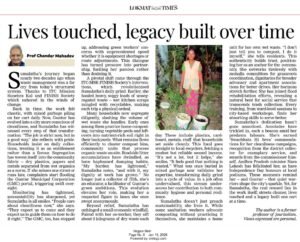
Last month, an article published in Lokmat Times drew widespread attention to Guntur—not through statistics or announcements, but through a deeply human story that reflected years of silent transformation. The feature highlighted how everyday sanitation work, when supported by the right systems and partnerships, can build dignity, resilience, and lasting urban change. At the heart of this story lies the collective impact of a project being implemented by FINISH Society with the support of ITC Mission Sunehara Kal.
Two decades ago, waste management in Guntur was largely unstructured. Mixed waste, overflowing carts, and informal practices defined the daily reality of sanitation workers. Over the years, however, the city has undergone a steady yet powerful shift. Today, Guntur stands more aware, more accountable, and more committed to cleanliness—and this transformation has been shaped through consistent community engagement and system strengthening.
The FINISH Society–ITC Mission Sunehara Kal partnership has played a key role in this journey by focusing on source segregation, decentralised composting, and behaviour change. Households now segregate wet and dry waste as a routine practice. Organic waste is composted at home or processed through cluster and community composting units, while clean dry waste moves efficiently to recyclers. This has reduced roadside dumping, eased pressure on landfills, and improved overall urban hygiene.
What makes this change significant is that it is not only technical—it is deeply human. Sanitation workers are no longer seen only as collectors of waste, but as educators, facilitators, and anchors of sustainable practices within communities. Through regular training, ward-level engagement, and city workshops, frontline workers have been equipped with knowledge, confidence, and a voice. Their lived practice—such as composting at home themselves—has strengthened trust and inspired households to follow suit.
The article also highlighted how improved coordination with the Guntur Municipal Corporation has enhanced accountability and responsiveness. Faster grievance redressal, better equipment support, and open dialogue have transformed daily challenges into a sense of partnership. This ecosystem approach—linking municipal systems, community participation, and worker empowerment—has become a defining feature of Guntur’s sanitation model.
Recognition has followed. From cleanliness campaign commendations to district and state-level honours, these acknowledgements reflect the collective effort behind Guntur’s progress. Yet, as the Lokmat Times article poignantly noted, the real reward lies beyond awards—in cleaner streets, healthier neighbourhoods, improved livelihoods, and the dignity of work restored.
By bringing this story to a national audience, Lokmat Times reminded us that sustainable urban transformation is built quietly, over time. As FINISH Society continues its work with ITC Mission Sunehara Kal in Guntur, the city stands as a powerful example of how people-centric sanitation systems can touch lives and build a legacy—one street, one household, and one cart at a time.
