
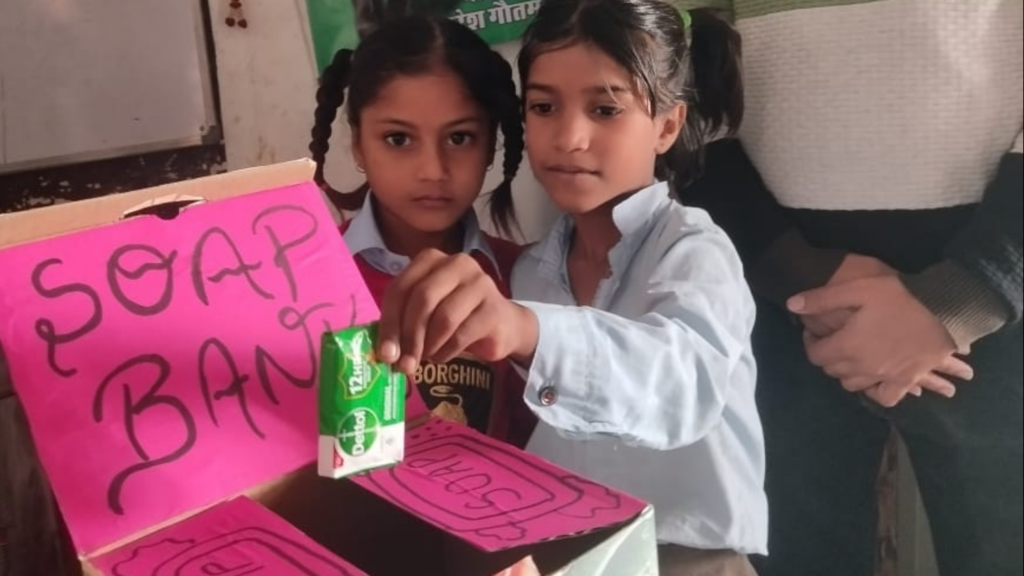
Soap Bank That Made All The Difference
“Where everyone once asked—‘Where is the soap?’ the children created the answer: The Success Story of the Soap Bank”
“Everyone says we must wash our hands with soap before meals and after using the toilet… but where is the soap?”
This was the question that echoed almost every morning in a government school in Alwar.
Just before the mid–day meal, a child would reach the handwash platform, turn on the tap, water would flow… but the soap was missing. Teachers would remind them, “Washing hands is important, make it a habit,” but the child’s innocent reply was always the same—
“Sir, but there is no soap!”
And this is exactly where the story of the Soap Bank begins—
a small problem that led children, teachers, and parents toward a thoughtful and lasting solution.
Under the Swachh Jeevan Project, supported by METSO India, the FINISH Society team was working to strengthen handwashing habits and behaviour change among students. The team had previously established successful “Soap Bank” models in other regions. Their experience was clear—if hygiene practices must be sustained, one needs not only resources but also ownership.
With this understanding, the conversation in this school took a new direction.
During a school assembly, the FINISH Society team asked:
“Is washing hands important?”
The children answered together, “Yes!”
“Then why is there no soap?”
Silence. After a moment, Mohit from Class 6 said softly,
“Sir, the soap gets finished… and the new one takes time to come.”
That moment opened the door to a new idea:
“What if you all create your own Soap Bank? A place where soap is always available for every child.”
It wasn’t easy in the beginning. It had to be explained that this was not just a box for keeping soap—it was a symbol of responsibility.
The school management supported the idea wholeheartedly. The Principal said, “If children take the lead, this change will sustain. We are with you.”
The following week, children gathered again—this time with excitement.
They were introduced to the idea of forming a Children’s Parliament. Elections were held—Child Prime Minister, Hygiene Minister, Finance Minister, Monitoring Minister… each position chosen by students themselves.
Neha from Class 7 was elected Hygiene Minister. With pride she declared,
“Now soap will never run out in our school. We will take care of it!”
Soon after, children collected old cardboard boxes and crafted a colourful, beautifully decorated box with large letters:
“Our Soap Bank – Our Responsibility”
The next step was to change a long-standing school tradition.
Children often distributed chocolates on their birthdays. FINISH Society explained—
“A chocolate lasts a few seconds, but a bar of soap can help the whole class for days.”
Children embraced the idea wholeheartedly.
That very week, Aryan—whose birthday it was—did not bring chocolates.
Instead, he placed a ₹10 soap bar in the Soap Bank.
“I brought soap for my friends today… so no one has to wash hands without it,” he said proudly.
This small act became a movement. Teachers, staff, and even local education officials appreciated the initiative.
When the METSO India team visited, they were delighted. They said,
“This is real behaviour change. Providing resources is easy, but maintaining them—children have mastered that.”
Within weeks, the impact was visible:
The handwash platform always had soap.
Children lined up before meals with confidence—because clean hands were no longer uncertain.
The Children’s Parliament created a monitoring register tracking how much soap came in, how much was used, and when to refill.
One day, the same child who once asked, “Sir, there is no soap,” washed his hands and smiled—
“Now it’s always here! This is our Soap Bank!”
The school administration adopted this model in their annual hygiene plan. The education department also indicated that this could be replicated in other schools.
Today, in this school in Alwar, the Soap Bank is not just a box—
it is a symbol of student leadership, collective responsibility, and sustainable hygiene.
The combined efforts of FINISH Society, METSO India, and the school team have shown that when children are trusted with leadership, even the smallest idea can bring about meaningful change.
The story leaves a simple message—
“When responsibility is placed in the hands of children, hygiene becomes not just a habit, but a culture.”
Till today, under the Swachh Jeevan Project supported by METSO India, FINISH Society has successfully developed Soap Banks in 18 schools across Alwar.
